Ping IP Address Online – Fast & Free Tool 2026
When I first started working with networks, the most reliable way to figure out if something was wrong was to simply ping IP Address it. That instinct hasn’t changed a ping tool cuts straight to the truth, telling you instantly whether a destination is reachable or not, without any guesswork involved.
An online ping utility sends ICMP packets toward a target IP address or domain, then waits for a response. If the host is live, you get latency, response time, and availability data back in milliseconds everything you need to diagnose a connection problem before it turns into something bigger.
What is IPv4?
Before you can ping anything meaningfully, it helps to understand what you’re actually targeting. IPv4 Internet Protocol Version 4 is the most widely used form of IP address in networking today, and every address under this system is 32-bits long. DNS A records handle the mapping between a hostname and its corresponding IP address, making the whole lookup process seamless from the user’s side.
IPv4 was the first protocol of its kind created for networking and despite being decades old, it still powers the majority of internet traffic. The catch is scale the maximum number of unique addresses ever available to be assigned to devices is capped at 4,294,967,296, a number that seemed enormous at the time but proved short as connected devices multiplied globally.
What is Ping?
Data moving across a network doesn’t travel as a stream it moves as individually transmitted blocks called packets, each taking its own route to the destination before being re-assembled into the original message on arrival. That’s how computer networking actually works, and it’s also exactly where things can break down.
Network congestion, a webserver going down, or some other technical error can stop those packets from completing the journey. Two standard diagnostic programs ping and traceroute exist specifically to diagnose these obstructions, connectivity failures, and network errors before they escalate.
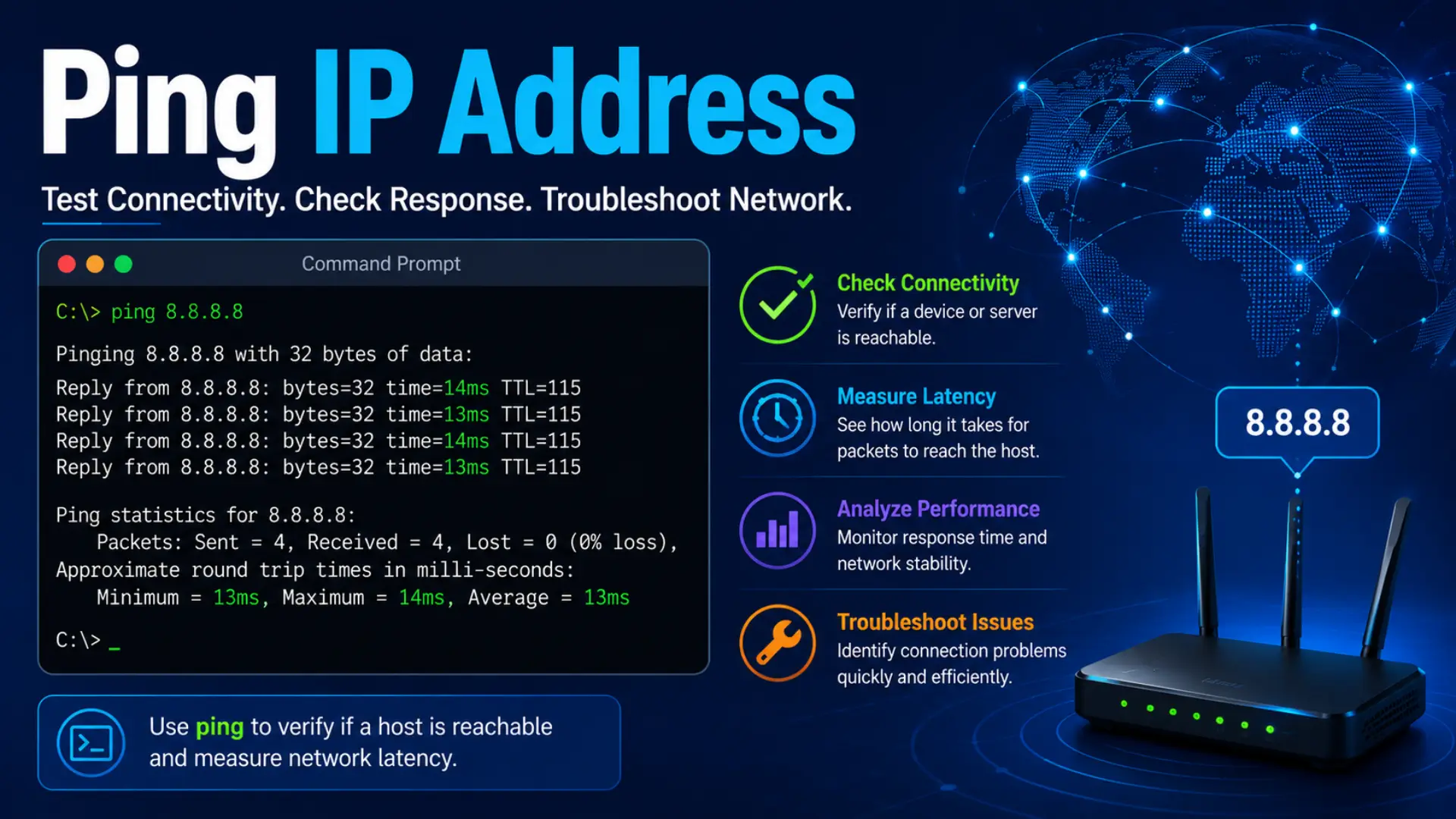
Ping short for Packet InterNet Groper works by sending an ICMP echo request to a target IP address or domain and listening for an ICMP echo response back. Per RFC1122, every host on the internet is required to reply when pinged. The tool operates using the Internet Control Message Protocol as detailed in RFC792, and each packet sent is 64 bytes total 56 data bytes plus 8 bytes of protocol reader information.
Beyond reachability, ping gives you round trip time a single number that reveals a lot about the health of the connection between your device and the host. That said, not every host replies:
- Firewalls often block echo requests to prevent DDoS (distributed denial of service) attacks
- Some hosts reduce their visibility on the network deliberately
- Occasionally, blocks happen by mistake
Publicly accessible addresses like 8.8.8.8 Google’s DNS server are a different story. These global DNS servers are designed to respond, and pinging them is completely fine. The entire flow data packet out, pong back, latency calculated happens in milliseconds, giving you real-time availability and response time data between any two electronic devices communicating across the network.
What is the Purpose of Pinging the IP Address?
A ping test does more than confirm whether a host is online or offline. Every time it runs, the IP Ping service fires several ICMP packets toward the target domain or IP and captures detailed output packets transmitted, packets lost, and the delay across each attempt. That data is enough to spot an unreliable connection before it causes real damage.
Here’s what a ping test actively helps with:
| Purpose | What It Tells You |
|---|---|
| Latency detection | Exact delay between your device and the target IP or domain |
| Server response time | How a website or hosted service performs under real network conditions |
| Network connectivity | Whether the basic connection between two computers is alive |
| DNS resolution verification | Confirms domain name resolves correctly, eliminating a whole category of issues |
| Security issue detection | Unexpected response time changes or data loss can flag unusual activity |
| IT management & monitoring | Lightweight visibility across multiple network nodes for uptime tracking |
| Website performance & efficiency | Real-world speed and response data beyond what dashboards report |
A good internet speed test works similarly establishing connections with three or four servers and using the one with the lowest connection time to run the actual test.
How to Use the Online Ping Tool?
Using an online ping tool is straightforward. Open the tool either an Online Ping IPv4 Address tool or a broader IP Ping Test tool supporting both IPv4 and IPv6 enter your target domain or IP address, and hit the Ping IPv4 or Ping Now button. The tool fires ICMP echo requests at the target and reports back on latency, packet response, and any data loss.
Here’s how to read the result:
| Result | What It Means |
|---|---|
| No data loss | Connection is secure, IP is online |
| Data loss present | Device or host is on an unreliable connection |
| Request timed out | IP is wrong, nonexistent, offline, or host settings are blocking ping responses |
| “Couldn’t resolve a hostname” | Invalid domain or malformed IP DNS lookup failed before the echo request went out |
Note: Online ping tools run from external infrastructure and test public-facing availability only. They cannot reach internal addresses on a local network. For testing resources inside a local network, use a local ping tool running from within that same network environment.Default IP Address for Huawei Routers
How Does the Ping Test Benefit You?
A single ping test result carries more diagnostic value than most people initially give it credit for. The tool is simple to use, but what it surfaces covers a wide range of real network scenarios:
FAQs About Ping IP Address
Is it illegal to ping an IP address?
Pinging an IP address is not illegal. An IP address functions similarly to public information comparable to a street address or house address visible and reachable by design. Sending a ping to check availability or test connectivity falls well within normal network behavior.
Where things shift is in how that information gets used:
- The ping itself not illegal
- Abusing IP data to target, track, or attack a device or network prohibited and unlawful
For anyone concerned about their own exposure, connecting through a VPN hides your IP before any outbound traffic hits the internet. Tools like a “what is my IP” checker combined with an IP address location tool can then confirm what the outside world actually sees useful for verifying your privacy setup is working correctly.
What’s a good ping?
Ping quality depends heavily on what you’re doing, but here’s a practical breakdown:
| Ping Range | Experience |
|---|---|
| Under 20ms | Fast connection feels immediate, essentially no lag |
| 40ms – 60ms | Good and acceptable for most use cases |
| Over 100ms | Noticeable delay significant lag territory |
| Around 170ms | Games may refuse connection entirely |
A 10ms ping (0.01 seconds) produces gameplay that’s noticeably faster and smoother compared to playing at 100ms. Games requiring precise inputs and tight timing are especially sensitive:
- High sensitivity (low ping required): Counter-Strike, Street Fighter V
- Low sensitivity (ping matters less): Hearthstone (turn-based, built-in tolerance)
Understanding the latency requirements of what you’re doing gaming, video calls, or browsing is the right way to evaluate whether your network performance is actually a problem.
What is a good ping response time?
A good ping response time comes down to one principle: the lowest value in milliseconds wins.
| Response Time | Assessment |
|---|---|
| Under 20ms | Fast seamless experience, lag essentially absent |
| 20ms – 100ms | Acceptable for most everyday use |
| Over 100ms | Worth investigating may indicate a connection, routing, or server issue |
As the distance between two points increases, response time naturally climbs. For demanding tasks, pushing toward sub-20ms makes a meaningful difference in performance.
Is it OK to ping Google DNS?
Pinging Google’s DNS server or any other globally accessible, web-based server on the internet is completely fine. Google doesn’t restrict ping traffic hitting their DNS infrastructure, and these servers handle enormous volumes of traffic at all times. A few pings from a single publicly accessible connection barely register.
What makes pinging a well-known DNS server genuinely useful is the reliability it offers as a test target:
- High response times to Google DNS → problem is likely on your end (connection, router, or ISP)
- Dropped packets to Google DNS → confirms a local network or connectivity issue rather than a server-side problem
It’s one of the cleanest ways to isolate where a network problem actually lives.